#image_title
Moods
At The Scrub Boutique, we believe that what you wear is more than just a uniform—it’s a tool for connection. For healthcare professionals, the long shift ahead is about clinical expertise, but the first impression you make is visual. In the high-stakes environment of patient care, every detail matters, from the fit of your fabric to the color of your scrubs.
While medical training focuses on the science of healing, the art of perception plays a silent but significant role in patient outcomes. Recent studies in medical sociology and psychology suggest that the color of a clinician’s scrubs can subconsciously influence a patient’s perception of their competence, trustworthiness, and empathy . As your premier provider of medical apparel in New Jersey and beyond, we’ve analyzed the latest research to help you make informed choices that foster healing and confidence before you even speak a word.
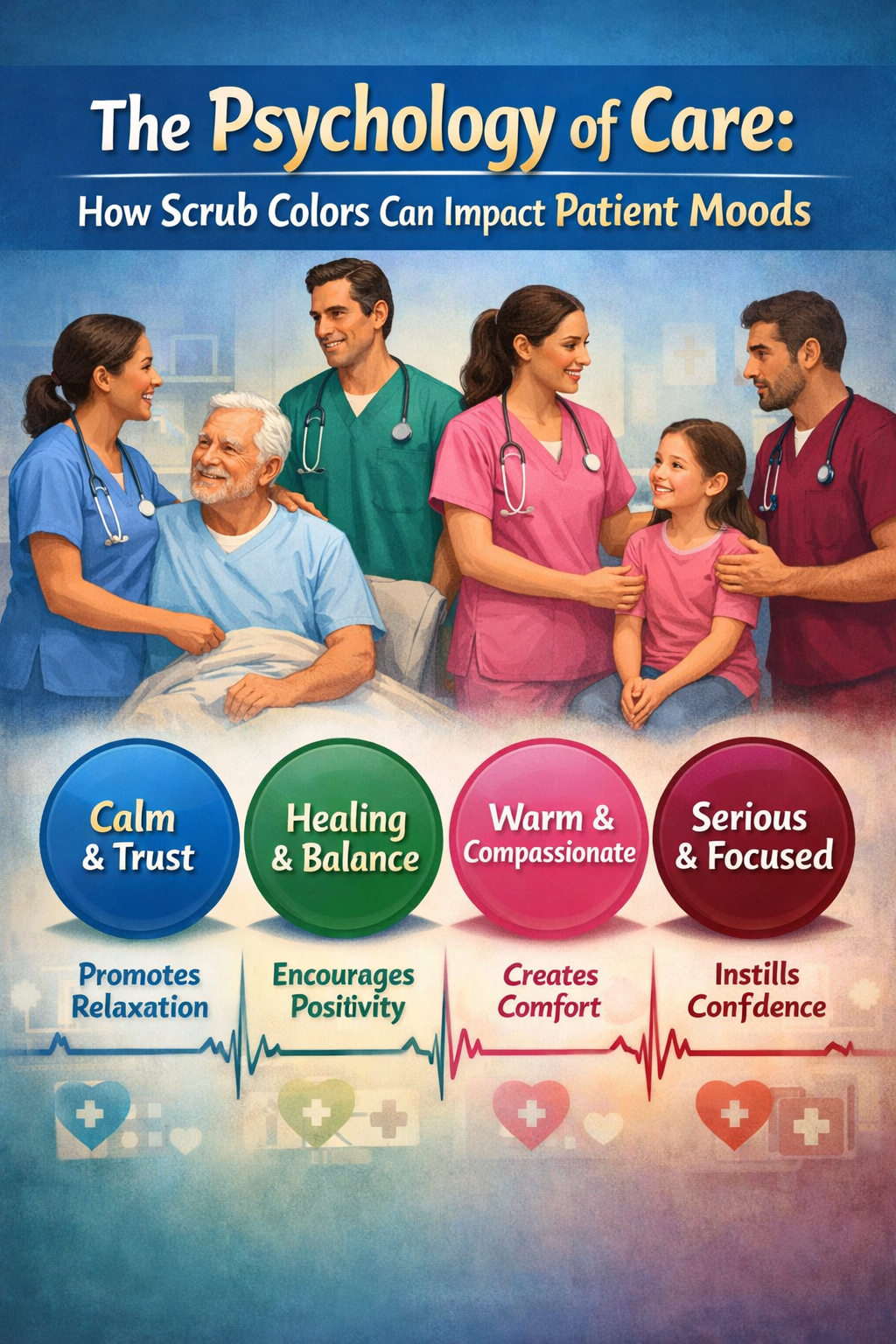
Here is how scrub colors impact patient moods and why your choice in attire is a crucial part of patient-centered care.
The Silent Language of Color in Healthcare
Humans are visual creatures, and color is a primary component of non-verbal communication. Color evokes psychological and emotional responses that are often deeply ingrained. In a healthcare setting, where patients often feel vulnerable and anxious, these visual cues become magnified. A patient’s trust in a physician begins with the first impression, and positive experiences during that initial encounter lead to continued trust and satisfaction .
Traditionally, the white coat has been the symbol of medicine for over a century, representing cleanliness and scientific authority . However, the landscape of healthcare attire has shifted dramatically, particularly since the COVID-19 pandemic. Scrubs have become the default uniform in many settings, prized for their hygiene and practicality . But with this shift from the white coat to the rainbow of scrub colors available today—from the calming blues offered by brands like Figs to the bold hues of Jaanuu—a new question arises: what message does your scrub color send?
A landmark study published in JAMA Surgery in 2023 set out to answer exactly that. Researchers at the University of North Carolina presented patients with images of clinicians wearing different colored scrubs to gauge their perceptions. The results were a revelation for the medical community, confirming that “looks do matter” .
Green: The Surgeon’s Authority
In the study, green was the color most frequently associated with the role of a surgeon. Nearly half of the respondents identified both male and female clinicians in green scrubs as surgeons .
The Patient Perception: Green appears to convey a sense of authority and technical skill. This association likely stems from decades of surgical tradition, where green and blue were adopted to reduce eye strain in the operating room and provide a high-contrast alternative to the red of blood and tissue . Patients have come to link this color with the precision and expertise of the operating theater.
Impact on Mood: For a patient about to undergo a procedure, seeing a clinician in green scrubs might reinforce their confidence in the technical abilities of the team. It signals, “This person is a specialist.” However, the same study noted a slight nuance: while green signaled authority, it also had mixed reviews regarding “caring.” In fact, for female clinicians, green was sometimes ranked as appearing “least caring” .
The Scrub Boutique Insight: If you work in a surgical or procedural setting, green is a classic choice that aligns with patient expectations of expertise. However, if your role involves significant pre- or post-operative emotional support, you might consider balancing the authority of green with the empathy associated with other colors through accessories or outerwear.
Blue: The Empathy and Trust Champion
If green is the head, blue is the heart. The same JAMA Surgery study found that blue scrubs were overwhelmingly perceived as the most caring, regardless of the patient’s age or the clinician’s gender . Over half of the respondents associated blue with a caring demeanor.
The Patient Perception: Blue is often associated with calmness, stability, and trust. It is the color of the sky and the sea, evoking a sense of peace and reliability. This is why many police uniforms and corporate logos utilize blue—it projects authority without intimidation . In a medical context, this translates to a clinician who is not only knowledgeable but also approachable and compassionate.
Impact on Mood: For a patient feeling scared or uncertain, a caregiver in blue scrubs can subconsciously lower anxiety levels. It suggests a listening ear and a gentle hand. However, interestingly, the same study that ranked blue as most caring also saw it ranked slightly lower in perceived knowledge and skill compared to green, although it still scored positively overall . This suggests a trade-off between the perception of “warmth” and “competence,” a classic psychological dynamic.
The Scrub Boutique Insight: Blue is an excellent all-rounder. It is particularly effective in specialties requiring high levels of patient interaction and emotional labor, such as pediatrics, family medicine, and nursing. At The Scrub Boutique, we stock a wide range of blues, from the soft, calming light blues of Cherokee Infinity to the more authoritative navy of Grey‘s Anatomy, allowing you to tailor your shade to your specific patient population.
The Dark Side of the Spectrum: Proceed with Caution (Black)
While black scrubs may look sleek, stylish, and practical for hiding stains—a favorite among clinicians for their “slimming” and modern effect—the research sends a clear warning: patients generally view black scrubs negatively .
The Patient Perception: The JAMA Surgery study found that black scrubs had the most negative connotation of any color tested. Some patients explicitly stated that black scrubs looked “deathlike” or resembled a “mortician’s uniform” . In the psychology of color, black is often associated with formality, authority, and even mourning. In a hospital setting, where patients are already grappling with fears about mortality and serious illness, this association can be detrimental.
Impact on Mood: Encountering a clinician in black scrubs might increase a patient’s anxiety rather than alleviate it. It can create a psychological barrier, making the caregiver seem distant, unapproachable, or even ominous. While this is a subconscious reaction, it can hinder the development of the trusting rapport essential for healing.
The Scrub Boutique Insight: We recommend exercising caution with black scrubs in direct patient-facing roles. While they may be appropriate for administrative or behind-the-scenes laboratory work, a patient in a hospital bed may not respond well to the “dark” aesthetic. If you love dark colors for their practicality, consider a dark navy or charcoal, which offer a similar muted tone without the negative psychological baggage.
The Bright Spectrum and Patterned Scrubs
Beyond the basics of blue, green, and black, the world of medical apparel has exploded with color. Brands like WonderWink and Jaanuu offer bold prints and vibrant palettes. What does the science say about these?
International research provides fascinating insights into the use of bright and patterned scrubs. A Japanese study involving obstetric patients found that flower-patterned uniforms scored significantly higher in “kindness/healing effects” than plain-patterned ones . Specifically, larger floral patterns in bright colors were perceived as particularly warm and friendly.
The Patient Perception: Bright colors and patterns can humanize the clinician, making them seem more like an individual and less like an authority figure in a sterile environment. This is particularly effective in specialties dealing with children or in outpatient wellness settings where the goal is to create a spa-like, relaxing atmosphere.
Impact on Mood: In a dental clinic study, light red-purple (a soft pink or lavender) scrubs were rated as the most “favorable” by patients, scoring high on the “kindness/comfort” factor . These warm hues can evoke feelings of nurturing and safety. However, the same study noted that while warm colors scored high on kindness, cool colors like blue and green scored higher on “trust/responsibility” .
The Scrub Boutique Insight: Your choice should reflect your environment. For a medical spa or a pediatric ward, colorful prints and bright hues can put patients at ease and create a positive, uplifting culture . For a high-acuity emergency room or a surgical unit, sticking to the trusted cool tones (blue/green) might better project the competence and hygiene patients are looking for in a crisis .
Gender Dynamics and Patient Perception
Adding another layer of complexity, research shows that color perception is not gender-neutral. The way a color is interpreted can depend on the gender of the person wearing it, highlighting persistent biases in healthcare.
Studies have found that female physicians often face a “double bind.” Even when dressed identically to male colleagues in formal attire or scrubs, they are more likely to be misidentified as nurses or assistants . The JAMA Surgery study reinforced this, showing that while green scrubs made a male model look like a surgeon, a female in green was sometimes perceived as less caring .
The Patient Perception: Patients may hold different expectations for male and female clinicians. Male physicians are often perceived as more authoritative in formal attire, while female physicians in casual attire may face negative assumptions about their competence .
Impact on Mood: For patients, this can lead to confusion or a lack of clarity about who is in charge of their care. For clinicians, it adds an unnecessary layer of complexity to establishing authority and trust.
The Scrub Boutique Insight: While we cannot change societal biases overnight, being aware of them is the first step. Choosing colors that are strongly associated with the medical profession—such as the “caring” blue or the “skilled” green—can help counteract misidentification. A well-chosen, consistent scrub color becomes part of your professional brand, helping patients recognize your role instantly.
The Evolution of Trust: Post-Pandemic Preferences
The COVID-19 pandemic fundamentally altered patient perceptions of medical attire. As the world became hyper-aware of hygiene and infection control, scrubs and personal protective equipment (PPE) became symbols of safety .
Patients today often feel more comfortable with clinicians in scrubs than in traditional formal wear because scrubs visually signal that the wearer is prepared for a high-risk environment. This preference for perceived hygiene and technical preparedness is particularly strong in emergency departments and hospital wards .
This shift validates the increased use of scrubs across all specialties and underscores the importance of fabric choice. At The Scrub Boutique, we emphasize that color is just one part of the equation. The “feel” and function of the fabric—antimicrobial properties, fluid resistance, and breathability—also contribute to the patient’s perception of a modern, competent, and safe professional .
Practical Takeaways for Your Practice
So, how do you navigate the rainbow of options available at The Scrub Boutique? Here is a practical guide based on the science of patient perception:
1. Know Your Audience and Setting:
-
High-Acuity/Hospital Settings (ER, ICU, Surgery): Stick to the classics. Green projects surgical skill, while Blue projects calm competence and caring. These colors align with patient expectations for hygiene and professionalism in high-stress environments .
-
Outpatient/Primary Care: You have more flexibility. Navy or light blue builds trust, while softer colors like lavender or muted greens can enhance approachability and communication .
-
Pediatrics/Wellness/Spas: This is where you can have fun! Bright colors and fun prints from brands like WonderWink can lower a child’s anxiety and create a friendly, non-threatening atmosphere. Floral patterns and warm hues score high on “kindness” .
2. Avoid the “Mourning” Association:
Resist the urge to wear black scrubs in patient areas. While stylish, the psychological association with death and formality can be a barrier to building rapport with anxious patients .
3. Consistency Builds Recognition:
If your department or clinic adopts a color-coding system (e.g., blue for nurses, green for techs), it helps patients navigate their care team quickly. A quick visual cue can make a big difference in helping a patient feel oriented and secure .
4. Don’t Forget the Fabric:
Perception isn’t just about color. Wrinkled, stained, or ill-fitting scrubs of any color will project carelessness. Investing in high-quality, wrinkle-resistant, and fluid-repellent fabrics—like the 4-way stretch materials from Figs or the tech blends of Cherokee Infinity—ensures that the visual message of your color choice is reinforced by a polished, professional appearance .
Conclusion: Wear the Message of Healing
At The Scrub Boutique, located in the heart of New Jersey and serving healthcare professionals across the nation via 866-245-9816, we understand that your scrubs are your second skin. They carry you through 12-hour shifts and grueling procedures, but they also carry a message to every patient you meet.
The science is clear: scrub color impacts patient mood and perception. By choosing your attire thoughtfully, you are not just following a dress code; you are actively participating in the psychological healing of your patients. You are using every tool at your disposal—including the color of your sleeve—to build trust, convey empathy, and demonstrate competence.
Whether you are looking for the trusted reliability of Cherokee, the modern style of Jaanuu, or the eco-conscious comfort of Barco One, we are here to help you find the color that best tells your story. Because in the delicate dance of the doctor-patient relationship, every detail counts.
Visit us in New Jersey or online today to explore a collection curated not just for style, but for the science of care. Let’s choose the colors of healing together.
The Scrub Boutique
866-245-9816
New Jersey